
Vinyl Pyridine Latex (VP Latex)
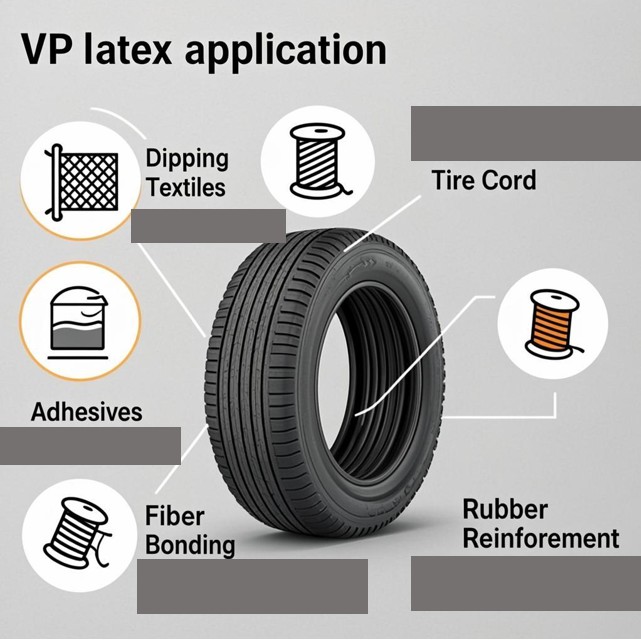
VP Latex is a specialty synthetic latex widely used in tire cord dipping and rubber reinforcement applications. It provides excellent adhesion between rubber and textile materials, improving mechanical strength and durability. With stable composition and high bonding efficiency, VP latex supports reliable performance in demanding industrial applications.
Description
Vinyl Pyridine Latex (VP Latex) — Tire Cord Dipping, Fiber Bonding & Adhesion Promoter
Vinyl pyridine latex (VP latex) is a specialty copolymer latex comprising vinyl pyridine, styrene, and butadiene monomers, specifically engineered for applications requiring exceptional adhesion between rubber matrices and reinforcing fibers. Its most significant and technically demanding application is in the tire manufacturing industry, where VP latex serves as the essential bonding agent in the treatment of textile and steel tire cords — the reinforcing fibers that provide structural strength to pneumatic tires. Without effective cord-to-rubber bonding, tires would experience premature cord separation, belt edge separation, and catastrophic tread separation failures under service conditions. VP latex’s unique ability to form strong, durable chemical bonds between polar fiber surfaces (rayon, nylon, polyester, aramid) and non-polar rubber compounds makes it irreplaceable in tire cord treatment formulations. Davar ChemTech supplies VP latex to tire cord manufacturers and tire producers in India, one of the world’s largest tire manufacturing nations with output exceeding 200 million tires annually.
The chemistry underlying VP latex’s adhesion performance is rooted in the vinyl pyridine monomer’s ability to participate in multiple bonding mechanisms simultaneously. The nitrogen-containing pyridine ring interacts strongly with polar fiber surfaces through hydrogen bonding and dipole interactions, while the butadiene segments co-vulcanize with the tire rubber compound during the curing process, creating covalent sulfur cross-links that mechanically anchor the rubber to the fiber. This dual adhesion mechanism — chemical bonding to the fiber surface on one side and covalent cross-linking to the rubber matrix on the other — is what gives VP latex-treated tire cords their extraordinary bond strength and durability. The styrene component contributes film hardness and dimensional stability to the dried latex film. This tri-monomer system provides a level of adhesion that cannot be achieved with SBR latex, natural rubber latex, or any other adhesive system, which is why VP latex remains the industry standard for tire cord dipping despite its higher cost compared to general-purpose latex grades.
VP Latex Product Range
- Standard VP latex (VP content 15%, styrene 15%, butadiene 70%): general-purpose tire cord dipping grade for polyester, nylon, and rayon cord treatment
- High-VP latex (VP content 19–20%): enhanced adhesion grade for demanding applications including aramid (Kevlar) cord treatment and high-speed tire reinforcement
- Carboxylated VP latex: modified grade with acrylic acid comonomer for improved adhesion to polyester tire cords and enhanced mechanical stability in dipping formulations
- Low-ammonia VP latex: reduced ammonia content grade for improved workplace air quality in tire cord dipping facilities with limited ventilation
- RFL-ready VP latex: pre-formulated latex designed for direct incorporation into resorcinol-formaldehyde-latex (RFL) dipping solutions without further modification
- Custom VP latex grades: tailored vinyl pyridine content, solids, and particle size for specific cord types, rubber compounds, and processing conditions
Industrial Applications
Key Application Sectors
| Industry / Sector | Application / Reason for Use |
| Tire Manufacturing | Essential bonding agent in RFL (resorcinol-formaldehyde-latex) dip treatment of polyester, nylon, rayon, and aramid tire cords; ensures cord-to-rubber adhesion for belt and carcass reinforcement |
| Conveyor Belting | Dipping treatment for textile reinforcement cords and fabrics used in rubber conveyor belts; provides durable adhesion between fabric plies and rubber skim coats |
| V-Belts & Timing Belts | Bonding agent for polyester and aramid reinforcement cords in automotive and industrial power transmission belts; prevents cord pull-out under dynamic loading |
| Hose & Rubber Reinforcement | Treatment of textile braiding and spiral reinforcement in hydraulic hoses, industrial hoses, and flexible connectors; ensures adhesion between reinforcement and rubber |
| Industrial Fabrics | Rubber-to-fabric bonding in coated fabrics, rubberized textiles, and inflatable structures; enables strong, durable bonding of rubber compounds to woven and knitted textiles |
| Footwear & Sports Goods | Adhesion promoter for rubber-to-fabric bonding in athletic shoe soles, sports ball bladders, and rubberized textile components |
Tire cord dipping represents the most technically critical application for VP latex, and understanding this process is essential for appreciating why VP latex quality has such a significant impact on tire performance and safety. The tire cord dipping process involves passing continuous strands of tire cord fabric through a two-stage treatment: first, a resorcinol-formaldehyde (RF) precondensate impregnation that forms an adhesive primer layer on the fiber surface, and second, an RFL (resorcinol-formaldehyde-latex) dip containing VP latex that deposits a bonding film onto the primed cord surface. After dipping, the treated cord is dried and cured at 220 to 250°C, during which the RF resin cross-links and the VP latex film co-cures with both the fiber surface and the tire rubber compound during the subsequent tire vulcanization process. The quality of the VP latex directly determines the H-adhesion (cord-to-rubber bond strength) and dynamic adhesion performance of the treated cord — metrics that are closely monitored by tire manufacturers because they directly influence tire durability, safety, and service life. Variations in VP latex solids content, vinyl pyridine content, particle size, or mechanical stability can cause bond strength fluctuations that lead to costly production rejects or, in worst cases, field failures.
The Indian tire industry has experienced remarkable growth over the past two decades, driven by the expansion of automotive production, road infrastructure development, and replacement tire demand. India is now the world’s second-largest tire manufacturer by volume, with major tire companies including MRF, JK Tyre, CEAT, Apollo, and Balkrishna Industries operating large-scale manufacturing facilities across the country. This production scale creates substantial demand for VP latex, as every pneumatic tire produced requires VP latex-treated reinforcement cords in its belt, carcass, and bead structures. The transition from nylon to polyester carcass cords in passenger car tires has been a particularly significant driver of VP latex demand, because polyester cords are more difficult to bond to rubber than nylon and require optimized VP latex formulations with elevated vinyl pyridine content or carboxylation modification to achieve adequate adhesion levels. Davar ChemTech supplies VP latex grades specifically optimized for polyester cord treatment, backed by adhesion performance data that demonstrates consistent H-adhesion values meeting tire industry specifications.
Beyond tire manufacturing, VP latex finds important applications in rubber reinforcement for industrial rubber products including conveyor belts, V-belts, timing belts, and hydraulic hoses. In these applications, textile reinforcement cords (polyester, aramid, or nylon) must be bonded to rubber compounds that provide the wear resistance, flexibility, and chemical resistance required for the end-use environment. The same RFL dipping process used for tire cord treatment is applied to industrial rubber reinforcement, with VP latex as the critical adhesion-promoting component. Conveyor belting, in particular, represents a significant application due to the demanding mechanical and environmental conditions that mining, cement, and steel industry conveyor belts must withstand — high tensile loads, dynamic flexing, abrasive material contact, and exposure to heat, moisture, and chemicals. VP latex-treated polyester reinforcement cords provide the adhesion durability required for these extreme service conditions, preventing belt delamination and splice failure during operation.
Technical Specifications
| Parameter | Standard VP Latex (Tire Cord Grade) |
| Chemical Type | Vinyl Pyridine-Styrene-Butadiene Terpolymer Emulsion |
| CAS Number | 25086-89-9 |
| Total Solids Content | 40–42% |
| Vinyl Pyridine Content | 15.0–17.0% |
| Styrene Content | 14.0–16.0% |
| pH | 10.5–12.0 |
| Viscosity at 25°C | 20–60 mPa·s |
| Surface Tension | 40–55 mN/m |
| Mechanical Stability | ≥ 300 seconds |
| Appearance | White to slight yellow milky liquid |
| Packaging | 200 kg HDPE drums / 1000 kg IBC totes / Bulk tanker |
| Shelf Life | 6 months (store at 5–35°C, sealed, protect from freezing) |
Storage, Handling & Safety
VP latex should be stored in a cool, dry, well-ventilated warehouse at temperatures between 5°C and 35°C. Like SBR latex, VP latex is susceptible to freezing damage — exposure to temperatures below 0°C causes irreversible coagulation that renders the material unusable. The higher ammonia content of VP latex (used to maintain alkaline pH stability) means that storage areas must have adequate ventilation to prevent ammonia vapor accumulation, which can cause respiratory irritation for workers. Containers must be kept tightly sealed to prevent ammonia loss and pH drop, which leads to gradual viscosity increase and eventual latex coagulation. Workers handling VP latex should wear chemical-resistant gloves, safety goggles, and where ventilation is limited, ammonia-compatible respirators. The ammonia odor of VP latex is significantly more pronounced than SBR latex, and workers may require acclimatization. VP latex should not be mixed with acids, oxidizing agents, or coagulant salts without proper formulation guidance, as these can cause rapid coagulation. Spills should be collected promptly — dried VP latex film forms a tough, rubbery deposit that is extremely difficult to remove from floors and equipment surfaces. VP latex is classified as non-dangerous for transport and is shipped as general cargo.
Supply & Distribution
Davar ChemTech maintains a dedicated VP latex inventory at our Vadodara distribution center, with temperature-controlled storage that preserves product stability. India’s tire cord manufacturers are concentrated in Gujarat, Rajasthan, and Tamil Nadu, while tire manufacturing facilities are distributed across Gujarat, Maharashtra, Tamil Nadu, Kerala, and Uttarakhand. Our strategic location on the NH-8 corridor and our established logistics network enable efficient delivery to these key consumption centers. We supply VP latex in 200 kg drums and 1000 kg IBC totes, with bulk tanker delivery available for high-volume tire cord treatment facilities. Each shipment is accompanied by a Certificate of Analysis detailing vinyl pyridine content, solids content, pH, viscosity, and mechanical stability, providing the quality documentation that tire industry quality systems require for incoming material acceptance.
Technical Partnership
VP latex is a technically demanding product where application performance is as important as material specifications. Tire cord manufacturers require VP latex that delivers consistent H-adhesion values, stable dipping solution rheology, and reliable cord coverage in their RFL dipping operations. Davar ChemTech provides application support that extends beyond material supply — our technical team can assist with RFL formulation optimization, dipping parameter guidance, and adhesion performance troubleshooting. We maintain relationships with leading tire cord treatment technology providers and can connect our customers with technical resources for complex adhesion challenges. This application-focused approach, combined with consistent product quality and reliable logistics, makes Davar ChemTech a valued VP latex supply partner for India’s tire and rubber reinforcement industries.
Require VP latex with consistent vinyl pyridine content and proven tire cord adhesion performance?
Contact Davar ChemTech for specifications, adhesion data, and supply arrangements.
Only logged in customers who have purchased this product may leave a review.


Reviews
There are no reviews yet.